Best Electric Massage Table (2026): Who Actually Needs One and Which to Buy
Every guide to electric massage tables lists the Earthlite Ellora, mentions it’s good for spas, and moves on. None of them answer the questions practitioners actually ask before spending $1,500 to $3,000: Do I genuinely need this, or am I buying something I don’t? At what point in my practice does electric justify the cost? What do I need to know before the table is delivered that nobody tells you?
This guide answers those questions honestly, then covers the two options worth considering on Amazon — one professional-grade, one accessible mid-range — with the practical detail the product pages leave out.
Answer 3 quick questions to get a recommendation.
1. Where do you work?
Table of Contents
Do You Actually Need an Electric Massage Table?
The honest answer depends on three things: where you work, how many sessions you do, and how long you plan to practise.
Where you work. An electric table is a fixed-room tool. It weighs between 100 and 200 lbs depending on model — it goes into a room and stays there. If you do mobile work, visit clients at home, or share a clinic space and move your table regularly, electric is the wrong category entirely. A quality portable table like the Earthlite Spirit handles mobile work. See: Best Portable Massage Table for Reiki Practitioners.
How many sessions you do. The ergonomic benefit of electric height adjustment is real but it compounds with volume. A practitioner doing 5 sessions a week and manually adjusting height between clients does this perhaps 5 times. A practitioner doing 25 sessions a week does it 125 times — plus adjustments mid-session when client positioning changes. The repetitive micromovement of manual adjustment, bending to unlock and re-lock legs, adds up at volume. As a rough guide: if you are seeing 15 or more clients per week in a fixed room, the ergonomic case for electric becomes genuinely persuasive. Under 10 sessions a week, it’s hard to justify the cost purely on ergonomic grounds.
How long you plan to practise. This is the argument most guides mention briefly and none develop properly. Repetitive strain injuries are the most common reason experienced practitioners reduce or stop their practice early — and poor table ergonomics is a documented contributing factor. The cost of an Earthlite Ellora spread across 15 years of practice is approximately $100 to $200 per year. The cost of treating a chronic shoulder or back injury — in treatment, in reduced session capacity, in time out of practice — is almost always higher. Practitioners who take the career-longevity argument seriously often view electric tables as a health investment, not a luxury upgrade.
Answer 3 quick questions to get a recommendation.
1. Where do you work?
What Electric Height Adjustment Actually Changes Day to Day
Most articles say electric tables allow you to “raise or lower the surface smoothly.” That’s technically accurate but misses what this means in practice.
With a manual portable table, height adjustment is a multi-step process: you crouch down, release the locking mechanism on each leg, slide it to the new position, re-lock, stand up, check the height, adjust again if needed. Between clients this takes 60 to 90 seconds and involves bending at least four times. Over a full working day this adds up — not dramatically, but cumulatively.
With an electric table, you press a button or tap a foot control and the surface moves. You can adjust while standing fully upright. You can change height mid-session if the client repositions, if you switch from standing bodywork to seated energy work, or if you simply notice your posture has drifted. The adjustment takes 10 to 15 seconds and requires no bending.
The Difference for Reiki Practitioners
If you’re a Reiki practitioner specifically this matters differently than for say a massage therapist. A Reiki session typically moves between standing positions above the client and seated positions at the head or foot. The optimal table height for these two positions differs — standing work requires a higher table, seated work a lower one. With a manual table you pick a compromise height and work around it. With electric you adjust as you move through the session.
Understanding the height range is essential when comparing tables. The Earthlite Ellora ranges from 18 to 37 inches — one of the widest ranges available. 18 inches at the low end is genuinely low: useful for helping clients on and off the table with limited mobility, for certain therapeutic positions, and for very low seated work. 37 inches at the high end accommodates taller practitioners working in standing positions without stooping. Narrower ranges on cheaper tables — typically 24 to 33 inches — cover the middle of the spectrum but sacrifice the extremes that matter in specific situations.
Quick Comparison: Electric Massage Tables
| Table | Height Range | Capacity | Best For |
|---|---|---|---|
| Earthlite Ellora | 18″–37″ | 600 lbs | Professional / permanent room |
| Sierra Comfort Electric Lift | 24″–35″ | 450 lbs | Mid-range / home clinic |
Nobody Tells You This Before the Table Arrives
Electric massage tables require practical preparation that portable tables don’t. Most buyers find this out after purchasing — here it is upfront.
Weight and delivery. The Earthlite Ellora weighs approximately 180 lbs assembled. It will not come up a staircase alone. You need another person, ideally two, plus clear access from the delivery point to the treatment room. Measure doorframes — 30 to 32 inch doorframes are common and the table’s width is typically 30 inches, which means it goes through upright but not with much clearance. If the table needs to go around tight corners, scout the route before delivery day.
Electrical access. The motor runs from a standard 120V socket. The cable from the table to the wall is typically 6 to 8 feet. Before buying, confirm there is a grounded outlet within that distance from where the table will sit — or plan for a quality extension cable. Avoid running the cable across a walkway where clients could trip.
Motor noise. This is the detail buyers worry about most and experience handles better than expected. The Ellora’s motor is quiet enough that most clients do not comment on it. The sound is a low hum during adjustment — audible but not disruptive. The practical approach is to adjust height before the client is on the table (between sessions) rather than during active treatment, which sidesteps the question entirely. Mid-session adjustment is available when needed but is not the default.
If the motor fails. Earthlite’s warranty covers the Ellora’s electrical components. In practice, motor failures on quality electric tables are uncommon — the mechanism is simple and robust. Worth knowing: in the event of a motor failure mid-session, most electric tables have a manual override or can be locked at their current height, meaning the session can continue. You will not be left with a table stuck at an unusable position.
Earthlite Ellora — The Professional Standard
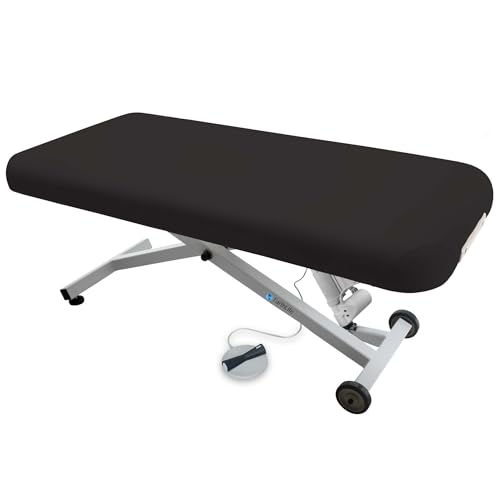
For me, the Ellora is probably the electric table that appears most consistently when experienced practitioners are asked what they use or wish they’d bought sooner. It is not cheap — and it is not trying to be. What it delivers is a professional-grade piece of equipment built to Earthlite’s standard of longevity, with a 18 to 37 inch height range that is wider than almost any comparable product, a reinforced steel frame, and a quiet motor that has proven reliable across years of daily professional use in spa and clinical environments.
The control options are practical: a hand pendant for fine adjustment during treatment and a foot control for hands-free operation when both hands are engaged with a client. The surface uses Earthlite’s Comfort-Flex upholstery — durable, easy to wipe down between sessions, and resilient over years of use. The 600 lb weight capacity covers the full range of client sizes comfortably.
For Reiki practitioners with a permanent treatment room seeing clients regularly, the Ellora’s 18-inch minimum is worth noting specifically. Seated work at the head of the table — which Reiki practitioners often sustain for 10 to 15 minutes at a time — is most comfortable when the table surface is at approximately seat height. At 18 inches, the Ellora accommodates this with chairs at standard height. Manual tables typically don’t go below 23 to 24 inches, which requires either a lower chair or a slightly awkward working angle. This is a practical advantage that gets almost no coverage in mainstream table reviews.
For a full review of the Earthlite range and how the Ellora compares to Earthlite’s portable tables, see: Best Earthlite Massage Table for Reiki.
Best for: Established practitioners with a permanent treatment room seeing 15 or more clients per week who want a lifetime professional table. The Ellora is the buy-once solution for a serious fixed practice.
Sierra Comfort Standard Electric Lift — The Accessible Mid-Range

The Sierra Comfort Electric Lift is the table that the top ranking guides do not cover — because it sits below the professional-grade price point that most industry publications focus on. It exists in the space between “I want a manual portable” and “I’m ready for an Earthlite Ellora.” For home clinic practitioners running a small practice, that space is real and underserved.
The two-section design — a flat lower section and a hinged backrest — is more versatile than a flat table for practitioners who use semi-reclined positions, which includes Reiki work in the third trimester of pregnancy and with clients who can’t lie fully flat. The backrest adjusts manually to various angles and stays in position.
The height range is 24 to 35 inches — narrower than the Ellora at both ends, which is the primary limitation. You lose the very low 18-inch setting and the very high 37-inch setting. For most practitioners working at standard heights, the range is adequate. For Reiki practitioners who want very low seated positioning, it is a limitation worth knowing about.
The motor is functional. It is louder than the Ellora — noticeably so. The practical solution, as above, is to adjust between sessions rather than during them. Build quality reflects the price point: solid for home clinic use at moderate volume, but not built to the Earthlite standard of 15 to 20 years of daily professional use. For a practitioner seeing 5 to 12 clients per week in a home setting, it is appropriate. For high-volume professional use, step up to the Ellora.
Weight capacity of 450 lbs covers the majority of clients. The table comes with a remote control for height adjustment and ships with the basic accessory package.
Best for: Home clinic practitioners seeing up to 12 clients per week who want electric height adjustment without the Earthlite price. Also suitable for practitioners with physical limitations who need electric adjustment at lower volume. Not the right choice for high-volume professional use.
Electric vs Hydraulic: The Practical Difference
These two terms appear interchangeably in searches but describe meaningfully different mechanisms.
Electric lift tables use a motor. You press a button or tap a foot control and the table surface moves smoothly. No physical effort required. They need electrical access. They have a motor that theoretically can fail (though rarely does on quality models).
Hydraulic tables use a foot pump. You press a pedal repeatedly to raise the table, and release a valve to lower it. No electricity needed — useful for locations without power access or for outdoor settings. The mechanism is mechanically simple and essentially never fails. The trade-off: raising the table requires repeated pump strokes (physical effort), and precision is harder to achieve than with an electric motor. They tend to be lower cost than electric.
For a permanent treatment room with electrical access, electric is almost always preferable — the one-touch adjustment genuinely outperforms a foot pump for day-to-day ergonomic use. Hydraulic tables make sense in specific situations: no power access, budget constraints, or preference for mechanical simplicity over convenience.
Frequently Asked Questions
Are electric massage tables worth the cost?
For practitioners with a permanent treatment room seeing 15 or more clients per week, the ergonomic benefit is real and compounds over years of practice. The career longevity argument is persuasive: practitioners who protect their body mechanics early typically practise longer. For mobile practitioners or low-volume home use, a quality portable table is more practical and appropriate. The cost is only justified when the table will be used consistently in a fixed location.
How much do electric massage tables weigh?
Significantly more than portable tables. The Earthlite Ellora is approximately 180 lbs. The Sierra Comfort is lighter but still over 100 lbs. Plan the delivery route before the table arrives — you need at least two people and clear access through doorframes.
Can I use an electric massage table for Reiki?
Yes — and electric tables offer a specific advantage for Reiki work that is rarely mentioned. Because Reiki sessions move between standing and seated positions at the head and foot of the table, height adjustments within a session are useful. The Ellora’s 18-inch minimum height also accommodates very low seated work at the head of the table more effectively than most portable tables, which typically don’t go below 23 to 24 inches.
What height should a massage table be for Reiki?
For standing work, approximately wrist height when your arms hang naturally. For seated work at the head or foot — which Reiki practitioners do extensively — the table surface should be at approximately seat height, typically 17 to 22 inches. Most manual portable tables cannot go this low. The Earthlite Ellora’s 18-inch minimum is genuinely useful for this position in a way that most tables, electric or otherwise, are not.
What happens if the motor on an electric table fails?
On quality electric tables, motor failure is uncommon. Most tables, including the Earthlite Ellora, can be locked at their current height in the event of a motor problem — meaning you can continue your session and the table won’t drop. Earthlite’s warranty covers electrical components. The Sierra Comfort has a shorter warranty period, which is worth factoring into your decision at lower price points.
Also see: Best Massage Table for Home Use | How to Set Up a Reiki Treatment Room | Best Earthlite Massage Table for Reiki | Reiki Table Accessories
Author Profile
-
Lily spent the first fifteen years of her career as a lawyer — contracts, arguments, precedent, and not much time for anything you'd call "energy work." A stress-related injury in her late 30s sent her to a massage therapist, and something about the work stuck.
She trained as a massage therapist herself, then kept going: Reiki certification, and a slow pull into the wider world of energy-based and spiritual practice she'd probably have cross-examined a witness for mentioning a decade earlier.
Now in her 50s, Lily runs RestoreQi the way she wishes a site like it had existed when she started out — written by someone who's actually done the training and tested the products, not just repackaged what everyone else says. She's still a practicing massage therapist and Reiki practitioner, and she brings the same habit from her legal career to everything she writes here: check the evidence, and don't take a claim at face value just because it sounds ancient.
Latest entries
 Singing BowlsJune 27, 2026Best Crystal Singing Bowls (2026): Top Picks for Every Budget
- Massage TablesMay 31, 2026Best Massage Table Face Cradle (2026): Comfort, Compatibility and the Sinus Problem Nobody Fixes
- Massage TablesMay 31, 2026Best Massage Table Sheets (2026): Material, Oil Resistance and How Many Sets You Actually Need
- Massage TablesMay 31, 2026Best Massage Table Warmer (2026): The Honest Comparison Professionals Need